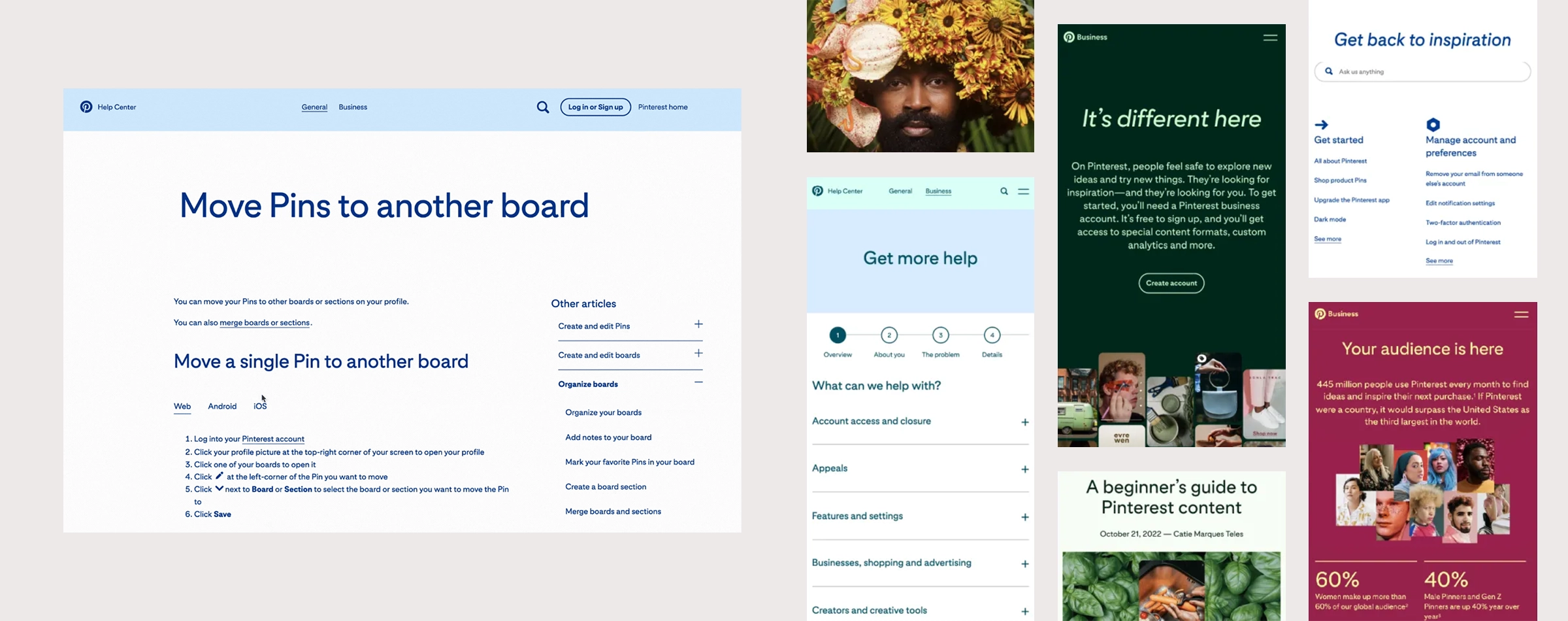

The problem
Help.Pinterest.com was a long list of FAQs. Pinners and advertisers who needed help creating a board, paying to promote a pin or troubleshooting a problem had to scan that list to find an answer, and the help desk system was slowing problem resolution for both groups. Issues the help center couldn't solve still had to reach Pinterest's internal help desk with the right information attached. Pinterest also wanted to understand how people behaved across its web properties without disrupting the pinner and advertiser experience.
Context
Pinterest is a visual discovery platform where people explore, save and share visual content, with 640 million monthly active users as of mid-2026. Its help content serves pinners and advertisers worldwide, including readers of right-to-left and Cyrillic languages. The help center rebuild didn’t start from scratch. Phase2 began working with Pinterest in 2016, architecting a Drupal 8 platform for a suite of marketing, business and community sites. The first, business.pinterest.com, launched in 31 languages through a custom Smartling integration and connected to Pinterest’s Salesforce CRM. A shared design system built on Pattern Lab kept every site on brand. Policy and Labs sites followed, and the help center rebuild began in 2018.
Our approach
Predictive NLP search across Drupal content
Help.Pinterest.com replaced its FAQ list with predictive search, the first step in the rebuild. A natural language processing system predicts what a user is asking, suggests search queries and sends them to the article that answers it. Results come straight from the help center's Drupal content and render in a React front end, so every answer traced back to an article Pinterest’s editors published and maintained. One source of truth for every answer is the same foundation today’s AI assistants need to respond accurately. The search interface uses the canonical design system already in place across Pinterest's other web properties, so it looks and behaves like the rest of the brand. For users, the change is direct: they type a question and get suggested answers instead of reading down a page of headings.
Right-to-left and Cyrillic help content
The design system handles right-to-left and Cyrillic languages, so one set of components serves every market. Visitors see personalized themes and dynamically generated pricing for their location. Pinterest's editors got a multilingual editorial experience with tutorials in their native languages, which simplified publishing and kept content culturally relevant inside one consistently branded interface. Phase2 also ran an accessibility audit and report in 2019, followed by design enhancements to the help center through 2020. Contact forms were rebuilt with conditional logic. When the help center can't solve a critical issue, the form asks for the details that issue needs and submits them to Pinterest's internal help desk system, which speeds up the support team's workflow.
A Segment event schema across properties
To understand behavior at scale, the team built a master data schema that maps, captures and tracks user events across Pinterest-owned web properties. The schema connects Segment's customer data platform (CDP) to client-facing web technology, internal business intelligence and KPI monitoring tools, and it keeps evolving as the properties change. Pinterest can analyze the data on the fly using anonymized customer profiles that follow interactions across its digital brand, gaining insight without exposing individual identities. Getting there took detailed planning, deliberate data design and collaboration between technology, data and content teams.