

No items found.
Acquia
Acquia Site Studio
No items found.

The problem

When ShareFile set out to launch a new brand and go to market by vertical, targeting accounting, finance and legal buyers, it ran into a problem. None of the martech underneath it was its own. The CMS, the Marketo instance and Salesforce were all shared with Citrix, and the seams showed. A segment built in one tool stayed in that tool. Leads lost data somewhere between Marketo and Salesforce. And marketing had no way to define an audience once and then reach it consistently, whether that meant email, the website or a sales follow-up. What ShareFile needed was a single customer data foundation, stood up quickly, with fewer integrations to maintain than the setup it was leaving.

Context

ShareFile is a B2B SaaS platform for secure file sharing, client portals, e-signature and virtual data rooms. Citrix acquired it years ago, and when Cloud Software Group bought Citrix, ShareFile was spun out as its own business unit. Independence on paper didn’t mean independence in practice, though. The website still ran on Adobe Experience Manager, and email and lead flow still went through Citrix’s Marketo setup. Updating content was slow, and so was launching an email campaign.

The team had three goals: grow digital-first revenue, improve trial-to-buy conversion through buying and onboarding experiences personalized by vertical, and give marketing a data foundation it could act on without waiting on IT. Leadership wanted every segment built once and used everywhere. They also wanted it fast, with six months of progress delivered in three.

Our approach

Segments built once in Acquia CDP

The team started with ShareFile’s data flows, not its page templates. Acquia handled the platform, and brand studio Athletics led design. Acquia CDP became the system of record for identity and segments, and it went live in the first release alongside marketing automation instead of being saved for a later phase. Because the CDP fed email, the website and on-site personalization, a single segment could drive all three. In the end, six Acquia products launched together: CMS, Site Studio, CDP, Campaign Studio, Personalization and DAM. All of it was built to meet ShareFile’s Okta SSO and AWS requirements.
‍

ShareFile

Snowflake data into one profile

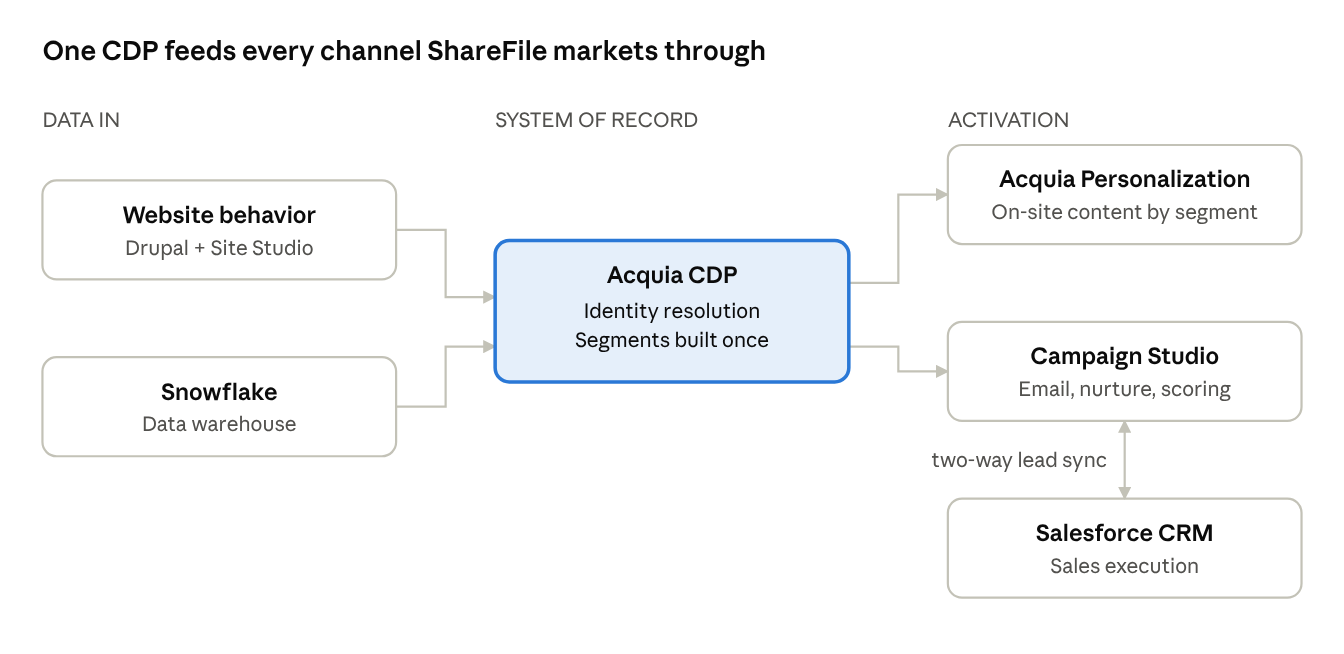
ShareFile’s customer data already lived in Snowflake, so the job was getting it into the CDP in a way that would last. That took data prep, ETL, reconciliation and tag management. The result was one CDP profile per buyer, built from both the warehouse and the web. Personalization, email and the hand-off to sales all pulled from that same record and the same segments. So when marketing built an audience, it was built once. The same buyer got a consistent experience on the site, in email and in sales follow-up, and nobody had to rebuild the segment in each tool.

‍

ShareFile data foundation · 2 sources, 1 CDP, 3 activation systems

‍

Marketo to Campaign Studio migration

ShareFile also left Citrix’s Marketo setup behind and moved its marketing automation fully onto Campaign Studio. Leads now synced in both directions between Campaign Studio and Salesforce, with lead scoring handled in Salesforce. That closed the gap where lead data used to go missing on its way to sales.

Site Studio launch with day-one personalization

The front end was built in Site Studio on Drupal, working from Athletics’ designs. At launch, 150 content pages moved over with 301 redirects and SEO metadata in place. Personalization started capturing data on day one, too. That meant personalization and email campaigns had visitor history to work with right away, without waiting months for it to build up.

Outcome

ShareFile’s new site went live four months after work began. All six Acquia products ran on one customer data foundation. ShareFile no longer depended on Marketo, and leads moved freely in both directions with Salesforce. Segments built in the CDP drove email and on-site personalization without being rebuilt in either tool, which was exactly what leadership had asked for at the start. ShareFile has since moved Podio.com onto the same platform.

A composable DXP doesn’t have to mean a pile of disconnected tools. It can run on one shared data model. Plenty of organizations are still untangling martech they inherited from a merger or a former parent company. If that sounds familiar, there’s no need to phase it over several years. Your warehouse, CDP, email, personalization and CRM can share one segment model, and you can plan to get there in a single release.