Governance You Can Fail: Five Principles and a Six-Month Test for Marketing Analytics
Data & Insights
Jason Hamrick, Principal Strategist
October 29, 2026
Most marketing organizations have some form of analytics governance in place. A RACI chart, a dashboard request process, a metric glossary. Far fewer can say with confidence whether that governance is working.
The gap usually traces back to how the framework was written. Governance documents tend to describe processes and roles in detail while leaving two questions unanswered: what is this framework supposed to accomplish, and how will we know if it did? Without those answers, governance can't succeed or fail in any measurable way.
This article lays out an alternative built on two components most frameworks skip. The first is a short set of guiding principles. The second is a set of behavioral success criteria specific enough to fail.
Why most governance frameworks stall
Governance rarely fails because the process diagrams are wrong. It fails for a handful of predictable reasons:
- Processes can't anticipate everything. When a request falls outside the documented flow and there are no principles to fall back on, the decision defaults to whoever has the most organizational influence. Repeat that enough times and the process becomes optional.
- Success is never defined. Without agreed criteria, any evaluation of the framework becomes a matter of opinion.
- After-the-fact scoring feels like an audit. Teams resist being graded against standards they never agreed to.
- Capacity is assumed, not stated. A framework handed to a team without the hours to run it will fail, and the framework usually takes the blame instead of the staffing gap.
Five principles for lasting governance
Principles guide decisions in situations the documented processes don't cover. We recommend starting with these five.
1. Refusal is the operative authority
Governance is tested by what it declines. An approval process that never says no simply adds a step to the queue. The analytics team should have clear authority to decline requests against published criteria, and leadership should back that authority in writing before it is used for the first time. Waiting until a senior stakeholder pushes back is too late to establish that support.
2. A change is incomplete until it has propagated
Documenting a new metric definition is only the first step. A change is complete when every team whose numbers are affected has been notified and every impacted report has been updated. Many conflicting numbers in marketing reporting trace back to a change that was documented correctly but never communicated downstream.
3. Consistent before standardized
Channel teams may keep definitions that vary from the enterprise standard. A paid media team, for example, may count leads differently from the executive scorecard for legitimate reasons. What they can't do is change those definitions without a documented reason, or publish them under the enterprise metric's name. Insisting on full standardization from day one tends to create friction that undermines adoption.
4. Every rule outlives the person who wrote it
Governance should not depend on any single individual. In practice, this means:
- Every artifact lives in a location the organization owns
- Every role has a named alternate
- Every output is written so someone who wasn't in the room can understand and act on it
5. The artifacts enforce each other
Governance artifacts are most effective when they reinforce one another:
- Executive reporting won't include a metric that isn't in the metric register
- Intake won't schedule work that arrives outside the request queue
- Dashboards missing from the inventory receive no support
- Vendor deliverables that don't meet the reporting standard are returned before acceptance
A metric register on its own is a reference document. Once executive reporting depends on it, teams have a reason to keep it current.
The six-month test
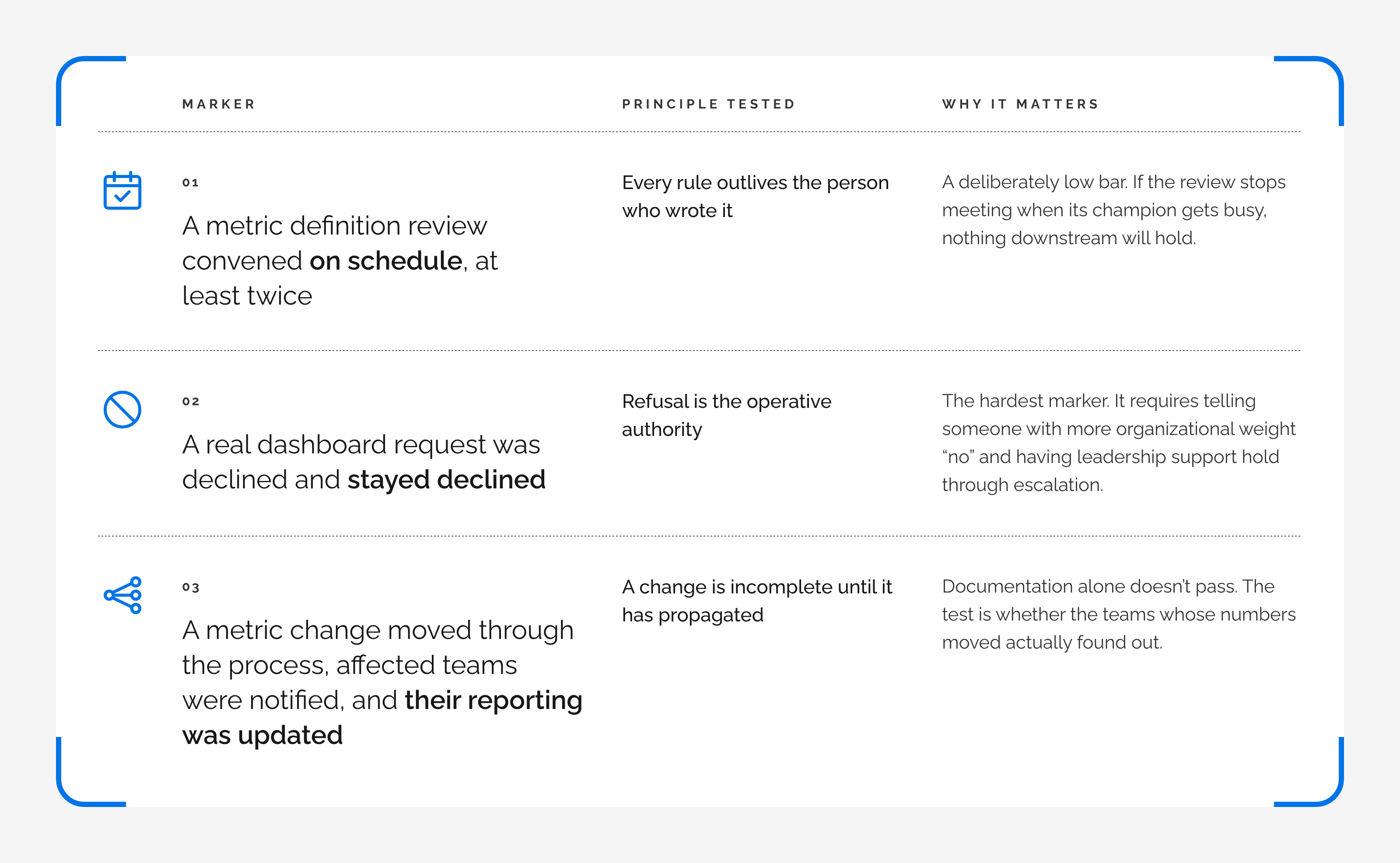
Principles describe how people are expected to behave. The six-month test checks whether that behavior actually happened. It focuses on the three principles most likely to erode under day-to-day pressure, and each marker is observable and binary: at the six-month mark, it either happened or it didn't.
What passing the refusal marker looks like
Consider a service line leader who requests a new dashboard that duplicates an existing one with slightly different appointment logic. The analytics team declines, cites the published criteria, and points to the existing dashboard. The request escalates to the senior marketing leader, who supports the decision because the criteria were agreed to in advance. That full sequence is what the marker measures. If the dashboard is built anyway after escalation, the refusal authority existed only on paper.
Why two principles aren't tested directly
"Consistent before standardized" and "The artifacts enforce each other" are structural. They tend to hold when the other three do, and when they slip, the failure typically surfaces as a missed marker.
Adopting the test and reading the results
Agree on the criteria before the clock starts
Propose the markers alongside the principles and secure agreement before the six-month period begins. Criteria agreed to in advance function as a shared goal. Criteria applied afterward feel like a performance review, and they meet resistance.
At the same time:
- Name an owner for the six-month check. A review that depends on someone remembering it is unlikely to happen.
- State the capacity dependency in the framework itself. If the team running governance lacks the time to do it, the document should say so, so that a staffing gap is recognized as a staffing gap.
- Publish what the analytics team does and when to engage it. Teams that have never worked with a centralized analytics function can't be expected to know when to bring it in.
Interpreting the results
Each missed marker points to the principle that didn't hold, which makes diagnosis much more specific:
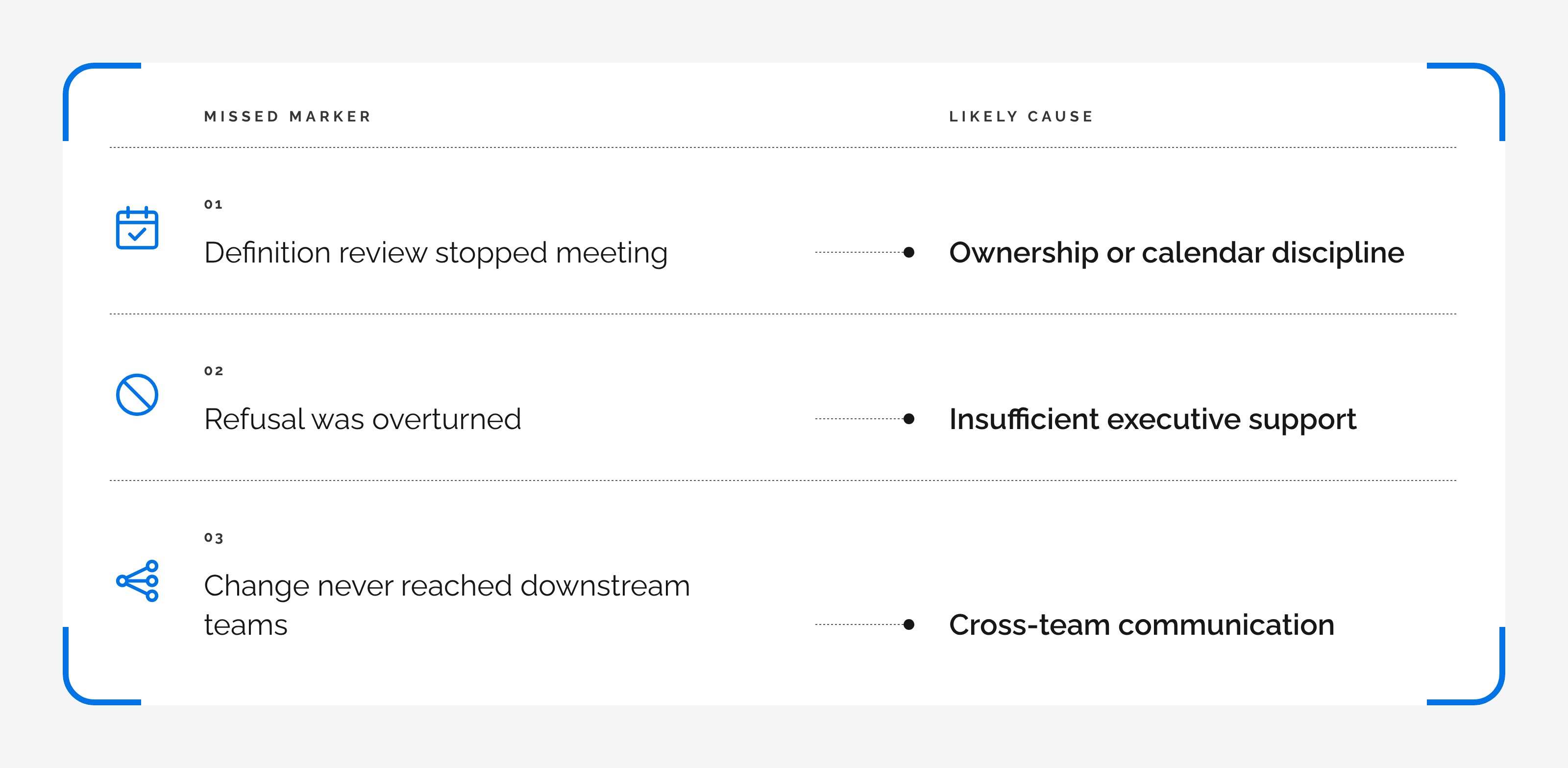
If all three markers were met, the framework is functioning and there are solid grounds to extend it. If one was missed, the organization knows exactly where to focus next.
Where to start
You don't need a new framework to apply this. Start with the one you have:
- Find the refusal. Locate the language that says who can decline a request, on what grounds, and who backs that decision when it escalates. If it's missing, or lacks a named leader behind it, that's the first revision.
- Add the three markers. Write them into the framework document and set a review date six months out.
- Share them before you start counting. Walk the people who will be held to the criteria through them in advance. That conversation often reveals whether the authority you assumed was ever actually agreed to.
Governance seldom fails all at once. It erodes as exceptions accumulate and no one checks. A dated, behavioral test is one of the simplest ways to catch that erosion while there's still time to correct it.