I've Seen This Movie Before.
Artificial Intelligence
Mike Potter, Principal Engineer
April 16, 2026
Back in October 1992, I walked into the Moscone Center in San Francisco for Interop, one of the biggest networking conferences of the era. I'd seen a lot of tech demos before, but one stopped me in my tracks.
A small booth was showing something called 10Base-T (Ethernet over ordinary Cat-5 telephone cable). Two computers, quietly exchanging data, surrounded by a deliberately hostile environment: electric motors running, vacuum cleaners humming, devices designed to generate every kind of electrical interference imaginable. And the data transfer was rock solid.
It doesn't sound like much today. But what I understood in that moment was that Ethernet had just escaped the lab. It no longer needed expensive, cumbersome thick coaxial cable snaked through walls by specialists. Now it could run over the same phone wiring already in every office building in the world. That demo didn't just show a better cable. It showed the beginning of the Internet revolution: the moment a transformative technology became something anyone could use, anywhere.
I hadn't felt that feeling again in thirty-plus years.
Until last week at HumanX 2026.
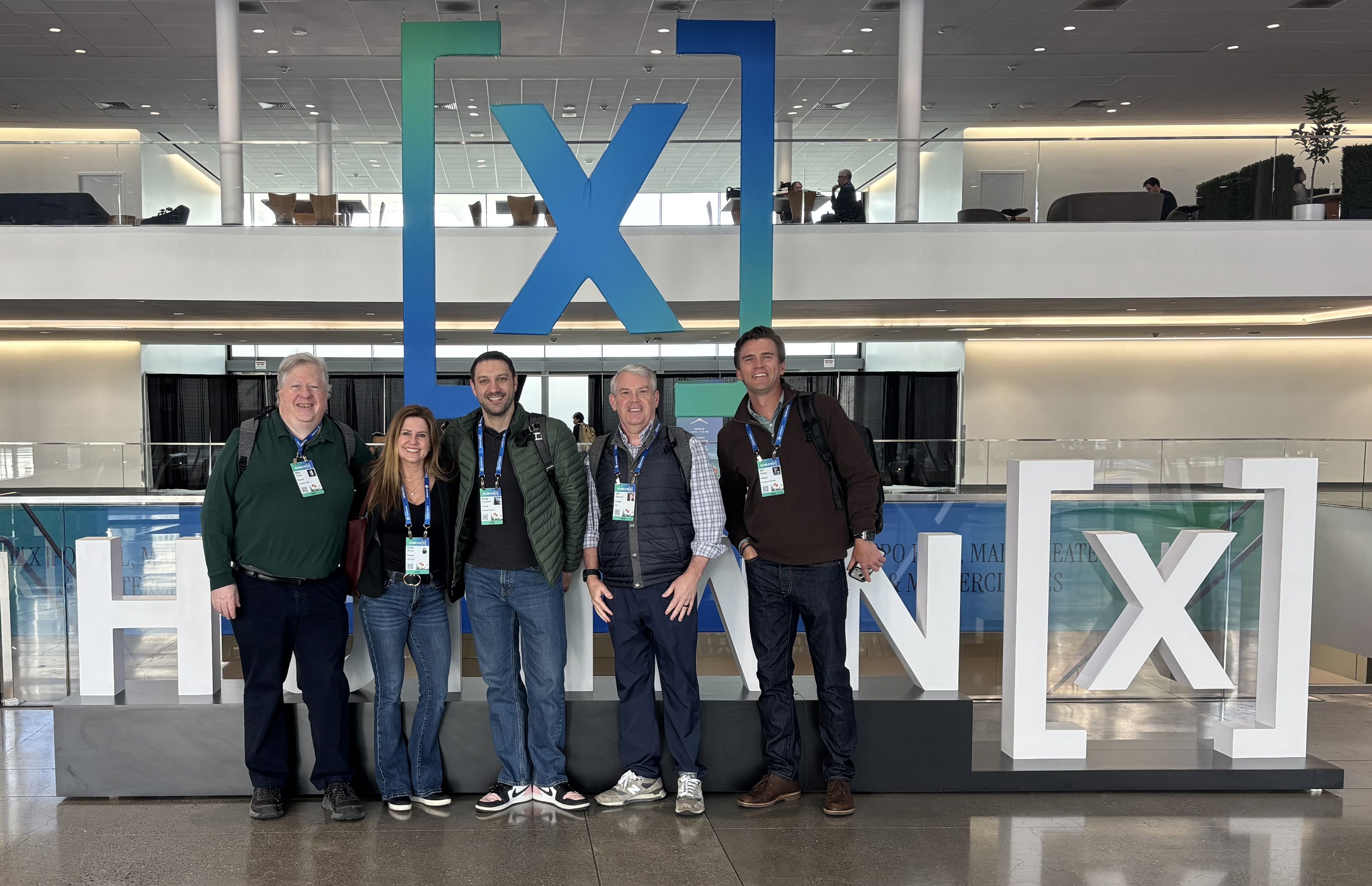
Welcome to the Next Revolution
HumanX brought together a remarkable cross-section of AI's most consequential voices: thousands of leaders, all under one roof at the same Moscone Center from Interop 34 years ago. The speaker roster read like a who's who of the AI world: Fei-Fei Li, Matt Garman, Bret Taylor, Andrew Ng, Ali Ghodsi, Vinod Khosla, Al Gore, Ray Kurzweil, and voices from Snowflake, Anthropic, NVIDIA, Perplexity, Zoom, Cursor, Salesforce, and dozens more. Speaker after speaker, I kept having the same déjà vu: agentic AI has been talked about for a while now, but this felt like the point where it stops being a topic and starts being a reality.
Not AI as a chatbot or a co-pilot that helps you write emails faster, but AI as an autonomous agent: something that can take a goal, connect to your systems and data, make decisions, take actions, and deliver results, all without a human clicking through each step.
The parallels to 1992 are striking. Just as 10Base-T democratized networking by making it accessible and practical, agentic AI is doing the same for intelligent automation. The question is no longer can AI do this? It's how do we actually deploy it at scale?
The Signal Through the Noise
Across every session and panel, a few themes surfaced over and over again:
- Agents are where the value actually lives. Every major platform company (Salesforce, AWS, Vercel, Sierra) agreed that generative AI's biggest ROI isn't in content creation. It's in agents that take action inside real business workflows: customer service, sales prep, code generation, HR processes. The companies winning are the ones moving from "demos" to production agents doing real work at scale.
- Adoption is a culture problem, not a technology problem. The companies successfully scaling AI aren't the ones with the best models; they're the ones that normalized AI use across every role, embedded it in existing workflows, and gave employees permission to experiment. The biggest adoption killers? Cultures where you have to be the smartest person in the room, or where using AI feels like admitting weakness.
- The workforce reskilling challenge is urgent and underestimated. Andrew Ng made a bold call: everyone should learn to code. Not because they'll write code by hand, but because AI makes it possible for non-engineers to build things, and those who can will dramatically outperform those who can't. Meanwhile, the gap between the pace of AI change and universities' ability to update their curricula is widening fast.
- Humans need to stay in the loop. Despite all the agentic enthusiasm, speaker after speaker was clear: humans still need to own the decisions that matter. AI handles the rote, the repetitive, the data-gathering, but accountability, judgment, and empathy remain human responsibilities. "People plus AI is a new way to work" was practically the conference motto.
Data Is the Hardest Problem, Still
If there was one problem that came up again and again, sometimes directly and sometimes quietly lurking under the surface, it was data. Specifically, the challenge of connecting AI to the right data, in the right context, with enough quality and trust to actually act on it.
The "garbage in, garbage out" problem is very real in the agentic era. When an agent can autonomously cancel an order, qualify a loan, or generate a report, bad data doesn't just produce a wrong answer, it can trigger a costly wrong action.
Several distinct data challenges kept surfacing:
- Most enterprise data is unstructured and hard to use. The good stuff isn't in clean spreadsheets. It's in videos, PDFs, Slack threads, email chains, and Confluence pages. RAG search and vector databases help, but they don't fully solve the problem of extracting reliable, contextual intelligence from this kind of data at scale.
- Data is siloed, and quality varies wildly. Agents need context from a dozen systems simultaneously, but those systems don't naturally talk to each other. And even when you can connect them, the quality of what's in them matters enormously.
- Data governance adds another layer of complexity. Not everyone should see everything, and neither should every agent. Different people have different access levels across different systems, and when an AI tries to synthesize information across all of them, enforcing those boundaries while still delivering useful answers is a genuinely hard problem. It's not just a technical challenge; it's an organizational and legal one too.
I've been working through exactly these challenges firsthand. Our team has been building what we call an Intelligence Layer for client projects: an agent that connects to the full project ecosystem (Slack, Google Drive, Jira, GitHub, Salesforce, and more). The goal is to give anyone on a project team the ability to ask natural language questions about project status, technical decisions, client context, and get accurate, grounded answers.
It works remarkably well, until you hit the data relationship problem. When the same information exists in multiple systems, which source is authoritative? If Jira says a ticket is closed but the related GitHub PR is still open, what does the agent say? If a client question was answered in a Slack thread and later updated in a Google Doc, which is current? These aren't AI problems; they're data integrity problems that AI inherits.
Some vendors are tackling this directly. DevRev's "Computer" product, for example, is built around the concept of Computer Memory: a unified, AI-ready layer that ingests data from across your tools and systems (structured and unstructured) into a single source of truth that agents can query and act on. It's an approach I’m watching closely.
I’m Here For It
HumanX 2026 felt like Interop 1992: the moment a transformative technology became practical, accessible, and unstoppable. Agentic AI is no longer a research project or a vendor pitch. It's running in production at companies around the world, doing real work, at real scale.
Not everything you see today will survive. Not every agent platform, not every AI startup, not every use case will make it. That's fine. The dotcom era gave us a lot of Pets.coms, but it also gave us Amazon.
The question for every practitioner and leader isn't whether to engage with agentic AI. It's whether you're going to be in the driver's seat when the revolution arrives, or scrambling to catch up after it passes you.
I know which side I plan to be on.
Interested in talking more about the Intelligence Layer we're building, or how AI agents can be applied to your business?
I'd love to connect.