CMS Interoperability Framework: What's Actually New?
Security
Danny Groh, SVP, Operations and Compliance Office
August 8, 2025
In July 2025, the Centers for Medicare & Medicaid Services (CMS) launched a voluntary Interoperability Framework with over 60 companies committing to enhanced healthcare data sharing by Q1 2026. For healthcare organizations trying to understand the implications, this represents another iteration in the ongoing effort to achieve seamless health information exchange.
Before diving into the details, it's worth asking: what's actually new here? This framework brings some genuinely fresh elements: CMS is putting their own Blue Button claims data into the mix, which could create real patient demand for interoperability. Modern identity solutions might finally solve user experience barriers, and the public commitments from major companies create meaningful momentum.
However, significant headwinds remain: this initiative is voluntary with no new enforcement mechanisms, economic incentives haven't changed (health systems still view data as a competitive advantage), and we still lack a national patient identifier to solve core technical challenges. The real question is whether market momentum and public commitments can overcome these persistent institutional barriers.
To understand how this framework operates, I find it helpful to think of it like an onion, with each layer representing different aspects of the interoperability challenge:
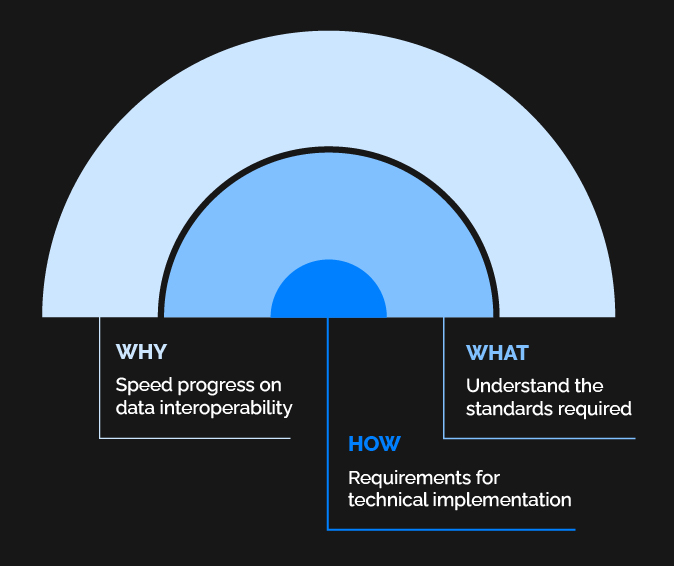
The Outer Layer: The "Why"
CMS describes this framework as a response to slow progress in data sharing. The driving forces here include the CMS mandate itself, plus existing regulations that continue to apply, including HIPAA, TEFCA (the national data sharing agreement), and the 21st Century Cures Act (which initiated current interoperability requirements), among others.
The key point? This framework doesn't replace existing compliance requirements. HIPAA obligations remain fully in effect, so you still need proper business associate agreements, identity verification, and all your usual privacy and security safeguards.
The Middle Layer: The "What"
This is where we get into the actual standards and networks that make interoperability work:
- FHIR is the technical backbone: think of it as the common language for health data APIs
- SMART on FHIR brings security and authentication to FHIR. It operationalized FHIR for apps that want access to EHR data.
- USCDI defines exactly what data gets shared and in what format
- QHIN is a network of organizations that have agreed to share health information using a common set of standards
- CMS Aligned Networks are the actual networks that meet CMS criteria (21 have already signed up)
These aren't brand new concepts, but CMS is now providing clear criteria for networks to become "CMS Aligned" and get listed as trusted partners in this ecosystem.
The Inner Layer: The "How"
Here's where the rubber meets the road with the actual technical implementation:
- APIs that respond quickly, ideally in real time
- Secure standards for authentication (no more remembering passwords for every healthcare website)
- Cross-network connectivity so different systems can actually talk to each other
- Facilitated FHIR through TEFCA that lets organizations exchange data directly without pre existing connections
Challenges to Solve
The complexity lies in the foundational challenges that determine whether technical interoperability can actually work in practice:
- Trust: No matter how robust the APIs or how compliant the systems, interoperability can not happen without trust between systems, entities, and individuals.
- Identity Without a National ID: We still don't have a national patient identifier, so matching patients across systems remains complex.
- Consent Management: Patients need to be able to control their data across multiple platforms and networks, which is easier said than done.
- Governance: Who makes the rules? How are they enforced? TEFCA provides some framework, but there's still a lot to figure out.
Preparing for the Framework: Key Considerations
As the CMS Interoperability Framework continues to gain momentum, health organizations must prepare not just technically, but strategically. This isn’t just about connecting APIs and calling it a day. Rather, it’s about building trust at scale.
Here are some key considerations:
- Regulatory clarity: Understand what’s mandatory vs what’s voluntary
- Technical readiness: Evaluate your FHIR and SMART on FIHR implementation, USCDI compliance, and existing API functionality
Network participation strategy: Decide whether to pursue CMS Aligned Network status directly, connect through existing partners, or work with health information exchanges - HIPAA program review: Ensure compliance frameworks can support expanded data sharing, including business associate agreements and access controls
- Identity and consent management: Develop systems for patient identification and consent across multiple platforms, which is likely the most challenging operational requirement.
- Technical and governance expertise: Consider partnerships for FHIR standards implementation, TEFCA integration, and the complex intersection of HIPAA with new framework obligations.
The Q1 2026 timeline creates both opportunity and urgency for organizations that begin strategic planning now.
Ready to assess your organization's interoperability readiness? Phase2 helps healthcare organizations navigate the complex intersection of technical implementation and regulatory compliance across all layers of the CMS framework. Connect with us to chat about your specific challenges and plot your strategic roadmap for 2026.
Ready to assess your organization's interoperability readiness?
Phase2 helps healthcare organizations navigate the complex intersection of technical implementation and regulatory compliance across all layers of the CMS framework. Connect with us to chat about your specific challenges and plot your strategic roadmap for 2026.